
Internalized Homophobia and the Inner Critic That Tried to Keep You Safe
There’s this idea that once you “come out”, you’ve achieved this idealistic level of self-acceptance because you took the courageous decision to share your identity with the world. Sharing your sexual and gender identity with those around you is truly an act of bravery; only those who are part of marginalized groups will truly understand what this feels like. For many of us, the courage doesn’t end there as we continue to slowly unravel the thread that kept us “in the closet” for so long, that deeply critical part that told us it wasn’t safe to come out, and may continue to be costing us in ways we aren’t even aware of. Coming out isn’t a point in time; it’s a meaningful process that begins from the moment we open up to our true identity.
This deeply critical part is typically referred to as internalized homophobia. It shows up in the therapy room in many different forms. It tends to sound like caution, good judgment, or simply the way things are done. As a gay therapist with queer lived experience, I've met my own version of it and continue to uncover how it shows up over 10 years after coming out. It’s been a deeply heartfelt and liberating journey, and I welcome you to read on to learn more about what it could mean to you.
Origins of Internalized Homophobia
Psychologist George Weinberg popularized the word "homophobia" in the late 1960s and located the problem in the fear and hostility directed at gay people (Weinberg, 1972). That was a radical position at a time when homosexuality was still classified as a mental disorder (luckily, we don’t do that anymore). A decade later, Malyon (1982) brought the term "internalized homophobia" into clinical writing to describe what happens when that hostility gets taken in. If you grow up surrounded by messages that being queer is wrong or shameful, some part of you absorbs those messages and starts applying them to yourself, often long before you have words for who you are.
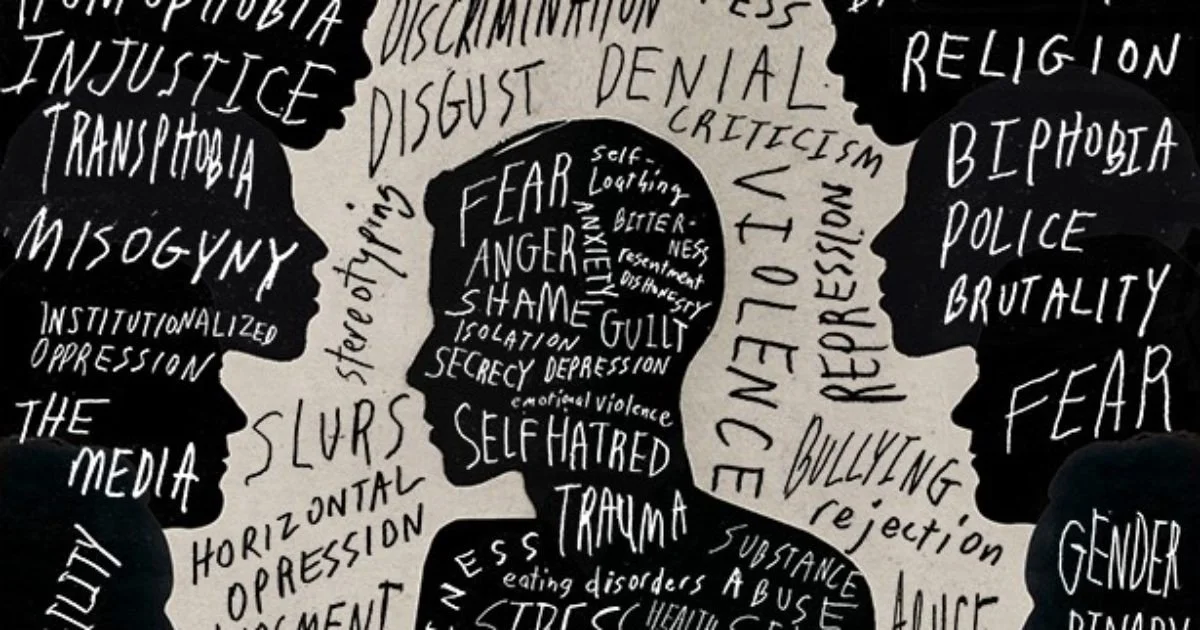
A framework that helps shape how I think about this is Meyer's (2003) minority stress model. Meyer distinguished between stressors that come from outside, like discrimination and violence, and stressors queer people end up carrying internally: expecting rejection, concealing who we are (masking and covering), and internalized homophobia itself. His model explained the higher rates of depression and anxiety in queer communities as a response to living in a hostile environment, which moved the conversation away from treating queerness as the source of the problem. A meta-analysis by Newcomb and Mustanski (2010) found a consistent link between internalized homophobia and depression and anxiety, and Hatzenbuehler (2009) has mapped how stigma "gets under the skin" by shaping how we regulate emotions and how we see ourselves and other people.
Taken together, the research points somewhere I find relieving for clients. Internalized homophobia is a predictable outcome of growing up queer in a world organized around heteronormativity, cisnormativity, and mononormativity. Having it doesn't mean you've failed at self-acceptance or haven't done enough work. It means that you’re human and weren’t immune to the messages of hate that made it’s way through your home, school, film and TV, and hurt by the oppressive systems that effect us all.
*A note on language: "internalized homophobia" is the established term in the research, and I'm using it because it's the one most people recognize. The same process applies to internalized biphobia and transphobia, and to the messages about gender that so many queer people absorb. If you're bisexual, transgender, nonbinary, or still figuring it out, you may also identify with parts of this theory.
No Bad Parts: Meeting the Inner Critic
Internal Family Systems (IFS), developed by Richard Schwartz, starts from the idea that the mind is made up of different parts, each with its own feelings, beliefs, and job. The title of Schwartz's (2021) book sums up the stance I bring into the room: No Bad Parts. Even the parts of us that cause the most pain are trying to help.
Two kinds of parts matter most here. There are hurt parts, often younger, that carry painful experiences we couldn't make sense of at the time. IFS calls these exiles, because the rest of the system works hard to keep them out of sight. And there are protective parts, which organize themselves around making sure we never feel that hurt again. Some protectors act as managers. They run your life proactively, planning, monitoring, and controlling so that nothing gets close enough to touch that deep, deep pain that was so hurtful once upon a time (and yes, it still hurts today).
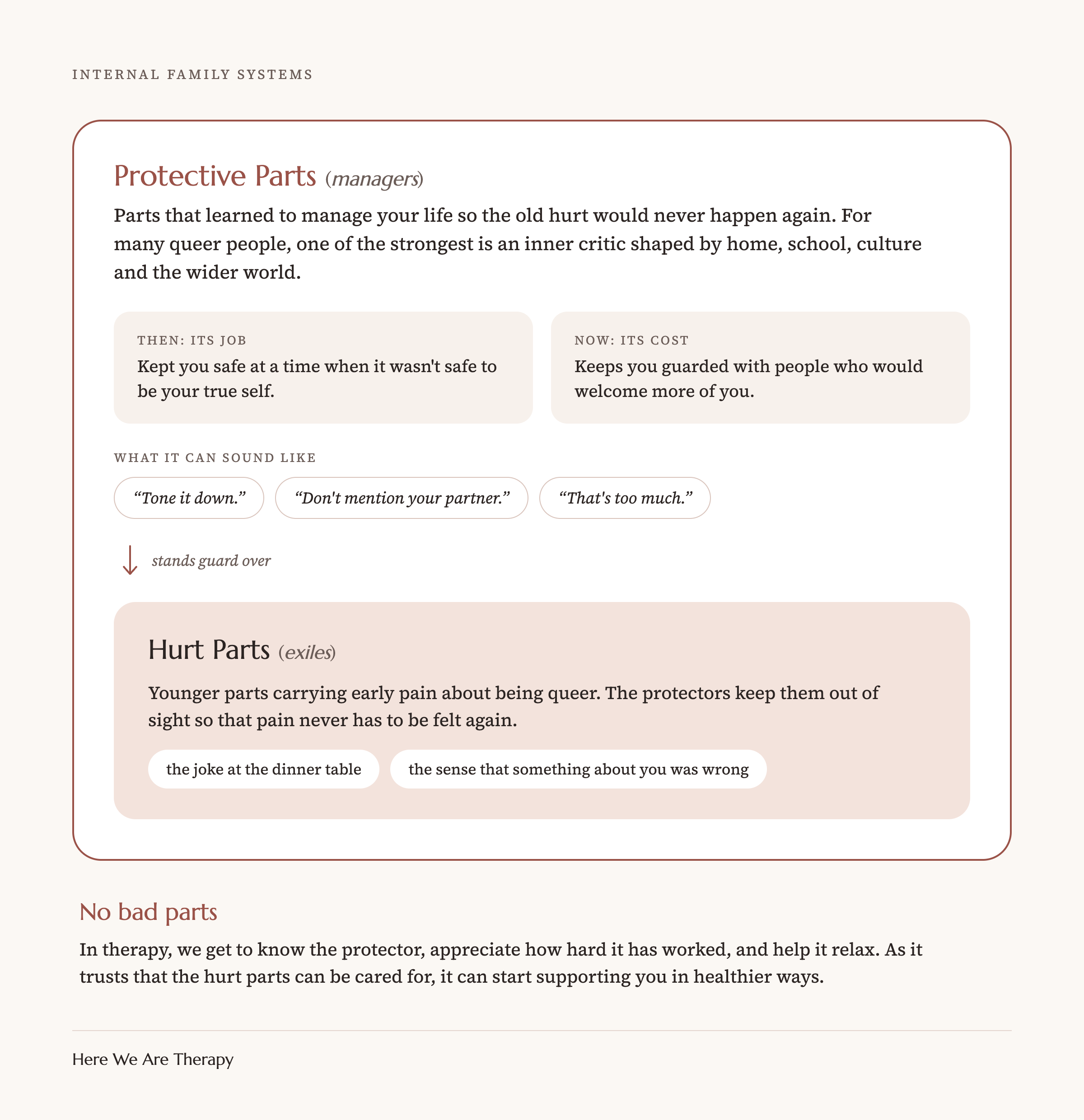
Many queer people carry a lot of hurt from their early years. The moment a parent's face changed. The joke at the dinner table that everyone laughed at. The friend who pulled away, the sermon, the schoolyard word you didn't fully understand but knew was about you (i.e., “that’s so gay”). Movies where queer characters were punchlines or died before the credits. A culture or family lineage with firm rules about men, women, and who gets to love whom. For some people it was loud, and for others it was a slow accumulation of small signals, and the younger parts of us took all of it in. These experiences were traumatic in the moment for our psyche to metabolize, so we buried them away (i.e., exiles) and learnt to behave in ways we never had to feel this again (i.e., protectors). IFS also describes legacy burdens, beliefs passed down through families and cultures that didn't originate with us (Schwartz, 2021). Much of what we learned about queerness was handed to us this way. So we got really, really good at protecting ourselves by fitting in, masking, dismissing our needs, and doing whatever we needed to be safe, to be loved.
Internalized homophobia often shows up as one of the strongest protective parts a queer person carries: an inner critic that learned to manage your life so that the hurt would never happen again. Its logic made sense at the time: “If I catch what's wrong with you before anyone else does, we'll be safe”. So it edits your voice and your clothes. It flags the gesture that's "too much," the desire that's "too obvious," the relationship that isn't "real" enough. It works relentlessly, often for decades, because as far as it knows, the danger never ended.
The trouble is that a strategy built for a child in an unsafe environment doesn't always change over time. Hence, our protective parts still feel the need to keep that inner child safe, so it never feels that hurt again. The critic keeps managing your life as though you're still in that environment, even when you're an adult with a supportive partner, chosen family, and a career you've proudly built. What once protected you now limits you. It keeps you guarded with people who would welcome more of you, and it keeps the hurt parts underneath from getting the care they needed in the first place.
When people try to fight this critic, shove it down, or feel ashamed of having it, it usually digs in harder. That's what protective parts do when they feel attacked: they double down. Any of this feeling familiar yet?
How It Shows Up in Real Life
Internalized homophobia looks different for everyone, which is part of why it's easy to miss and there’s no silver bullet. Here are a few different domains where we see this creep up.
At Work
Work is often where the critic is most active, because it's where many of us still feel we have so much to lose. It can look like using gender-neutral language for your partner or skipping the weekend story altogether. It can look like being out at work in principle while carefully controlling how out you are: fine to mention a same-sex partner, less fine to wear what you'd wear on a Saturday. Legal scholar Kenji Yoshino (2006) called this covering: toning down a known identity so other people stay comfortable.
It can also look like overachievement. Pachankis and Hatzenbuehler (2013) tested what's been called the "best little boy in the world" hypothesis and found that young queer men were more likely than heterosexual peers to base their self-worth on achievement, a pattern linked to experiences of stigma. If you can't be acceptable for who you are, the logic goes, you can at least be impressive. I see this often in queer clients who are exceptionally capable, where some of the drive turns out to be a protector, making sure no one ever has a reason to reject them, making sure they’re of value, doing everything they can to feel worthy. This in turn can lead to chronic fatigue, interpersonal struggles with coworkers, workplace overwhelm, and burnout.
With Family
For many queer folks, the family home is where many of these messages started, so it makes sense that the critic gets loud here. A lot of queer adults notice themselves shrinking back into an older version of themselves at family gatherings. You might leave your partner at home for the holidays, or bring them and keep any affection out of sight. A family that "doesn't have a problem with it" but never asks about your partner or your life is offering tolerance, and many queer adults have learned to call that acceptance.
The critic often shows up here as a loyalty bind: if I ask for more, I'm ungrateful, or I'm making this about me again. It's worth looking at how much you've learned to settle for, and whether that settling is something you'd choose today or a strategy from long ago. For many queer people, chosen family becomes the first place where being fully known feels possible, and that can be a powerful part of healing on its own.
In Intimate Relationships
This is where internalized homophobia is often hardest to see, because it hides inside closeness. It can show up as sexual shame, where pleasure comes with a hangover of guilt, or desires feel acceptable in the moment and unacceptable the next morning. It can show up as discomfort with your partner's gender expression, or your own, especially around femininity in men or masculinity in women. It can show up as a belief that your relationship has to look more stable and more conventional than anyone else's to count, leading you to follow the relationship escalator while you ask yourself: “Is this the kind of relationship I truly want?” It also affects how well you can receive love. When a protective part still believes something about you is fundamentally unacceptable, being loved well can feel unsettling: “If they really knew me, they'd leave”. That belief can lead people to push partners away, test them, or stay a half-step back.
For people in ethically non-monogamous relationships, the critic can pull in two directions. Some queer people may choose monogamy partly because it feels like the respectable way to be queer, the version easiest for family and coworkers to accept in a mononormative world. Others are drawn to polyamory or an open relationship but hold back because a voice says it would confirm every stereotype about queer people and sex. In both cases, the critic is deciding the structure of the relationship, and your actual values don't get a vote. Figuring out what you want without that voice making the call is some of the most freeing work I personally get to be part of in the therapy room.
In any relationship, two people bring two sets of protectors. When your partner's critic gets activated, it can set yours off, and a small disagreement ends up carrying decades of old fear. Learning to recognize when that's happening is often a turning point in couples therapy.
Getting to Know Your Version
There's no universal form of internalized homophobia, which I find to be hopeful. Your critic has its own history and its own phrases, and it gets loud in its own particular places. Getting to know it means getting to know the story of how you got through the years when it wasn't safe to be yourself.
Many of these beliefs operate below conscious awareness. You might not think of yourself as carrying any internalized homophobia, and still notice a tightness in your chest when your partner leans in to give you affection in public spaces, a sudden anxiety when discussing weekend plans with coworkers, or a big reaction to a small criticism from a friend. A few questions can help bring it into view:
Where in your life do you most “edit” yourself, and what do you imagine would happen if you stopped?
Whose voice does your critic sound like? A parent, a teacher, a culture, a schoolyard or maybe an older version of yourself?
What does the inner critic seem to be afraid of?
Is it loudest at work, with family, or with a partner? What's different about those spaces?
When did you first learn that something about you was “wrong” and needed to be managed?
Are you feeling a sense of chronic fatigue or built-up resentment that you just can’t place?
How Therapy Can Help
Therapy offers a space to explore your sexual and gender identity at your own pace, without anyone deciding for you what the answer should be. For some people that means making sense of an identity they've known about for decades. For others it means opening a question they've never let themselves ask. Either way, the work involves understanding what you were told to believe along the way, and how those beliefs, many of which you may not be aware of, are still shaping your choices at work, with family, and in your relationships.
In IFS-informed therapy, we don't try to get rid of the critic (trust me, that never works in the long run). We get to know it from a place of compassion and acceptance. We start by noticing when it's running the show, then get curious about what it's been trying to do for you. Most of the time, the answer is protection. It took on a hard job at a time when it wasn't safe to be your true self, and it has worked so hard at that job ever since. Thanking this part of you and offering it love often changes how it responds. Over time, as it trusts that the hurt parts it's been guarding can be cared for, the critic can begin to relax. I’m sorry to say, it doesn't disappear. However, it finds a different role, one that supports you in healthier ways instead of keeping you small. I also draw on Acceptance and Commitment Therapy in this work, which helps people loosen the grip of painful thoughts and take the brave decision to keep moving towards a life they truly value, rather than doing everything we can to avoid the hurt.
I'm a queer therapist, and while my story isn't yours, I know firsthand how persistent this critic can be, and how much it changes once you start to understand it. I offer individual therapy and LGBTQ2+ therapy in person in East Vancouver, as well as virtually. For some people, sitting in a room with someone who gets it makes this kind of exploration feel more possible. You can read more about me, check the FAQ, or book a free consultation to get started.
If something here sounded familiar, start small. This week, notice when the critic speaks up, stay curious and compassionate, and thank it for working so, so hard to protect you for so long. You may be surprised how your mind and body respond.
If you'd like company in figuring out what it's been protecting, I'm here for it.
Your fellow traveller, phil
References
Hatzenbuehler, M. L. (2009). How does sexual minority stigma "get under the skin"? A psychological mediation framework. Psychological Bulletin, 135(5), 707–730. https://doi.org/10.1037/a0016441
Malyon, A. K. (1982). Psychotherapeutic implications of internalized homophobia in gay men. Journal of Homosexuality, 7(2–3), 59–69. https://doi.org/10.1300/J082v07n02_08
Meyer, I. H. (2003). Prejudice, social stress, and mental health in lesbian, gay, and bisexual populations: Conceptual issues and research evidence. Psychological Bulletin, 129(5), 674–697. https://doi.org/10.1037/0033-2909.129.5.674
Newcomb, M. E., & Mustanski, B. (2010). Internalized homophobia and internalizing mental health problems: A meta-analytic review. Clinical Psychology Review, 30(8), 1019–1029. https://doi.org/10.1016/j.cpr.2010.07.003
Pachankis, J. E., & Hatzenbuehler, M. L. (2013). The social development of contingent self-worth in sexual minority young men: An empirical investigation of the "best little boy in the world" hypothesis. Basic and Applied Social Psychology, 35(2), 176–190. https://doi.org/10.1080/01973533.2013.764304
Schwartz, R. C. (2021). No bad parts: Healing trauma and restoring wholeness with the Internal Family Systems model. Sounds True.
Weinberg, G. (1972). Society and the healthy homosexual. St. Martin's Press.
Yoshino, K. (2006). Covering: The hidden assault on our civil rights. Random House.
