
Words Are Magic: How Nonviolent Communication Can Transform Your Relationships
"Words are, in my not-so-humble opinion, our most inexhaustible source of magic, capable of both inflicting injury and remedying it."- Albus Dumbledore
Remember that classic line we said as kids to deflect those mean-kid moments: “sticks and stones can hurt my bones but words cannot hurt me.” I think we got that all wrong. Words can absolutely hurt us, and those mean-kid moments can actually sting for many years to come. You’d figure we’d then decide to be more intentional about our words along the way to not hurt others, and use words in ways that help us feel closer to others. That unfortunately doesn’t often happen, and we carry these unhelpful ways of communicating into adulthood and into our most important relationships.
The vast majority of us have never learned to communicate skillfully, which results in us unconsciouly hurting others, pushing people away, and fueling disconnection. This blog post is about words, and how they can be skillfully utilized to help you feel more connected to yourself and others.
It’s Not Your Fault, You Just Never Learned How
Did you grow up around the dinner table being asked “what feelings did you carry with you today”? Did you learn in school how to tap into your feelings and needs, and communicate them with your peers? If so, lucky you! If not, welcome to the club. Most of us were socialized into learning that being rational, methodical, and being really good at math, essay writing, and memorizing textbooks were the path to success in life. Who would’ve known that mastering the art of relationships would be way more valuable to many of us than algebra (yes, I’m projecting my dislike for math here, sorry not sorry).
Think about what fights actually sound like in most relationships. Someone says something that lands wrong. The other person gets defensive. Maybe someone makes a comment that starts with "you always" or "you never” (hot tip, don’t use absolutes, that “never” goes well). The other shuts down or fires back. Nobody feels heard. Nobody feels safe. Somehow, you've ended up in an argument that has nothing to do with what either of you actually needed in the first place (referencing back to my previous post on what’s underneath the fight). This is what I call unskillful communication.
Queer folks have a whole additional layer to add here. So much of growing up queer, for many of us, involved learning to manage how we were perceived, so that we could fit in and experience the primal need to belong. This is how we kept ourselves safe. I spent a significant part of my life doing exactly that, and yes, there was a cost. When you're so focused on monitoring how you appear to others, you become an expert on diminishing your own feelings and needs. In my case, I dimmed my own feelings and needs to the point where I couldn’t name them. This doesn’t mean my feelings and needs went away. They instead surfaced as anxiety, frustration, and a whole host of unhealthy people-pleasing behaviours. I didn’t have the words to express my feelings and needs, and that distanced me from myself and imposed limits on my relationships (were people experiencing me or a version of me that I became a pro at covering).
Nonviolent Communication (NVC) completely shifted this experience for me. It opened up my internal world of feelings and needs, made a significant difference in my ability to self-regulate my emotions, and completely shifted how I have challenging, heartfelt conversations with people in my life. It's one of the most consistent tools I return to in my work with couples and individuals because it does something deceptively simple: it teaches you how to take ownership of your own internal experience and insecurities, and connect with yourself and your partner in a new and fulfilling way.
What’s NVC?
If you've seen couples therapy depicted in the media (not the Showtime series, that one’s actually excellent), you've probably encountered the way therapists say: “Don't say ‘you make me feel’, say ‘I feel’." This has become cultural shorthand for everything people find comedic or performative about therapy. The "I feel" statement has taken on a life of its own as a punchline, and honestly, when it's done badly, it earns it. There’s nothing more frustrating than someone mechanically inserting "I feel" into a sentence while still making everything about what the other person did wrong. Please, please, don’t weaponize the “I feel” line. Start practicing NVC instead.
NVC is a framework for communicating in a way that takes ownership of your own inner experience rather than leading with blame or judgment. Like any skill, most people are genuinely not very good at it at first. It takes practice, patience, and a willingness to slow down in moments when everything in you wants to speed up and defend yourself. In the beginning, it will probably feel clunky and, real talk, you’re going to fumble. Just like you had to practice math problems to learn algebra, you’ll have to practice NVC to learn how to connect. I may be biased here, but algebra is something we can live without, connection is not.
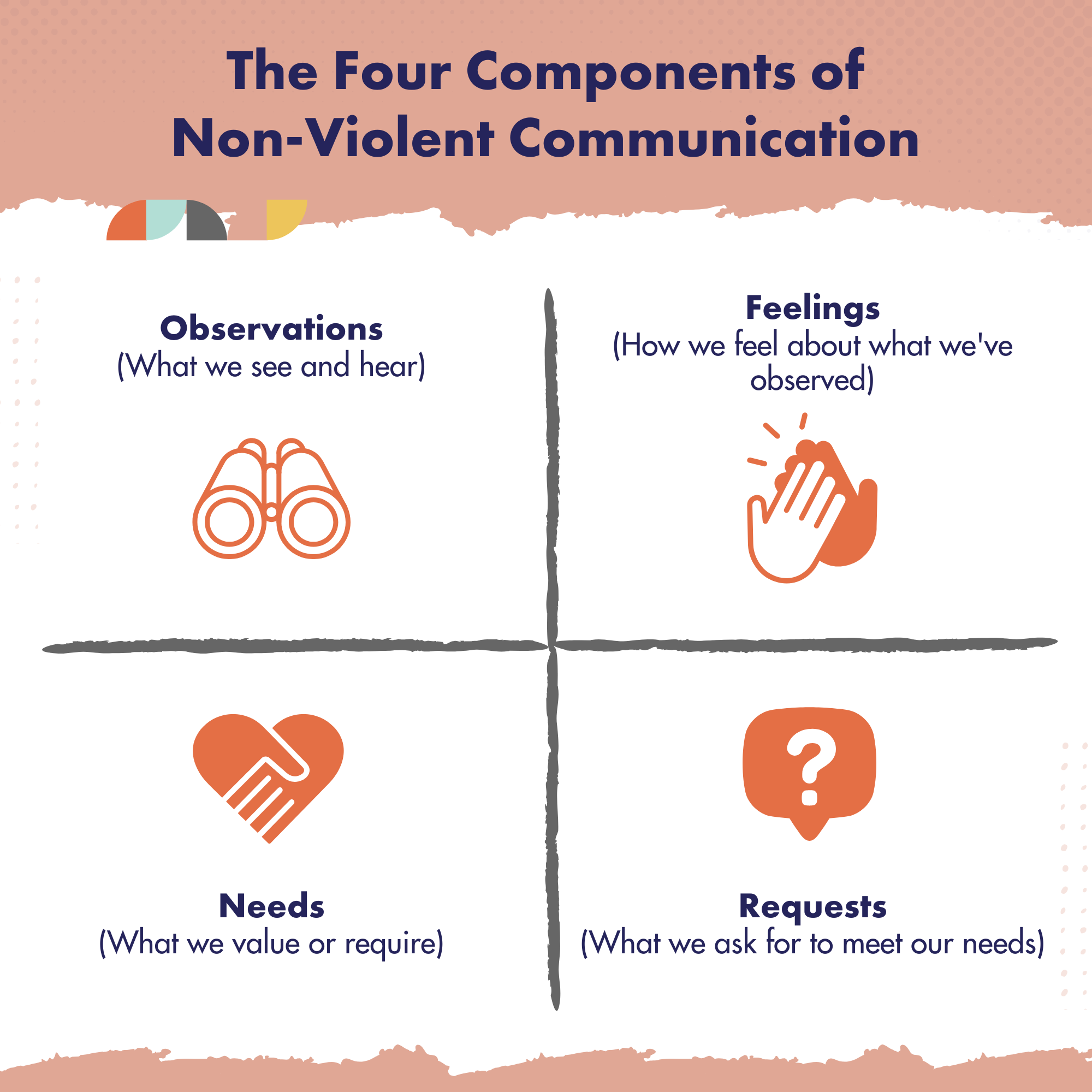
The framework is organized around four components: Observation, Feeling, Need, and Request.
Observation means describing what actually happened, as factually as possible, without interpretation or judgment. Not "you were being dismissive" but "you looked at your phone while I was talking." As a rule of thumb, you’re naming what can be described if there was a video recording of what occurred.
Feeling means naming what came up for you in response. Not "I feel like you don't care," which is actually a thought about the other person, but a genuine emotion: "I felt hurt" or "I felt invisible." Pro tip, if ever you’re saying “I feel like”, you’re not actually naming a feeling.
Need means identifying the underlying need that was or wasn’t being met. Most of us have very little practice articulating our needs without shame. Behind the hurt of being ignored while your partner scrolls might be a need for presence or connection. Those are valid needs you can and should name.
Request means asking for something specific and actionable. Not a demand, and not a vague plea for things to be different, but a clear and concrete ask: "When I'm sharing something with you, could you put your phone down?" Keep in mind, your partner is absolutely entitled to denying the request or telling you they can’t do it the exact way you’re asking, resulting in the need for a dialogue and creative problem-solving together.
Source: CultureAlly
Here's what that looks like in practice, contrasted against how the same moment usually goes.
Without NVC: "You're always (absolute) on your phone. You never (absolute) actually listen to me. You clearly don't care what I have to say (criticism)."
With NVC: "When you were on your phone while I was talking (observation), I felt frustrated (feeling), and that’s because I have a need for connection (need) that wasn’t being met in that moment. Would you be willing to put your phone away when we're having a conversation?"
Same situation. Completely different landing. The first version puts the other person on trial. The second opens a door for dialogue. NVC does not mean your requests will always be met. It opens up the space for a conversation with empathy and without defensiveness. You’re two different people, with two different unique makeups of feelings and needs, requiring you to engage in dialogue and find creative ways to have each of your needs be met. Pro tip, you aren’t in a relationship with your clone, respect that their needs will look different from yours.
One of the things that makes NVC so disarming, in the best possible way, is what it does to the dynamic in the relationship. When you stop making the problem about the other person and start taking ownership of your own feelings and needs, defensiveness starts to lose its grip. Your partner isn't being accused anymore. They can actually hear you. That shift, from combat to genuine communication, is the gold in NVC.
The NVC Institute offers a free inventory of feelings and needs that you can find here. If you've ever struggled to find words for what's happening inside you, it's a genuinely useful place to start. I’ve recommended that folks print this and post it somewhere visible and accessible in their home to easily reference as they practice NVC.
What Gets in the Way for Queer Couples
NVC is useful for any couple. But for queer couples, there are particular moments where the framework becomes especially important, because the triggers that get activated inside the relationship cut into old wounds that reinforce their lack of belonging and early beliefs that there’s something fundamentally flawed about them. Let’s see what that can look like.
Example one: The comment that lands on old wounds
One partner makes an offhand comment about the other's appearance. Intended as teasing, said without much thought. For a queer person who spent years absorbing messages that their body, their expression, or the way they moved through the world was wrong or too much, that comment doesn't just land as a joke. It lands on something much older and can be very hurtful.
Criticism and defensiveness:
Partner A: "You're so sensitive. It was just a joke."
Partner B: "Maybe think before you speak next time."
With NVC:
Partner B: "[Observation] When you made that comment about how I look, [Feeling] I felt ashamed and hurt. [Need] I need to feel fully accepted by you, especially when it comes to how I look and present myself. [Request] Would you be willing to be more mindful of comments like that going forward?"
Partner A: "I didn't realize it landed that way. I'm sorry. Tell me more."
Example two: Reaching out and being met with distance
One partner initiates closeness and the other pulls back. For a queer person who learned early that being too needy or too visible led to rejection, that withdrawal might be an old reflex that has nothing to do with their current partner. For the person reaching out, it lands directly on their fear of being unwanted.
Criticism and defensiveness:
Partner A: "You always pull away. I don't know why I even try."
Partner B: "I just needed space. Why do you always make it a big deal?"
With NVC:
Partner B: "[Observation] When I pulled away earlier, I want you to know it had nothing to do with you. [Feeling] I felt overwhelmed in that moment. [Need] I need some space sometimes to feel safe again before I can reconnect. [Request] Can we figure out a signal I can give you in the moment so you don't feel like I'm disappearing?"
Partner A: "[Observation] When you pull away without saying anything, [Feeling] I feel scared that I'm losing you. [Need] I need some reassurance that you're coming back. [Request] That signal would really help me."
These conversations are hard. They require a level of self-awareness and emotional courage that doesn't come easily, especially for people who spent years learning to suppress exactly this kind of inner knowing. But they are possible. And they transform your relationship.
NVC in Individual Therapy
While this post is focused on couples, NVC is just as valuable in individual therapy and something I work on regularly with individual clients.
For many people, the first step isn't learning how to communicate feelings and needs to a partner. It's learning how to identify them at all. For LGTBQ2+ folks, years of masking and covering and prioritizing how you're perceived over what you're actually experiencing can leave a person genuinely disconnected from their own inner life. NVC in individual therapy becomes a practice of reconnection. Learning to pause and ask: what am I actually feeling right now? What do I need? Building vocabulary for both, and then slowly building the confidence to assert those needs in relationships, in friendships, in the world.
On Fumbling and Repair
I know this framework. I believe in it. I use it in my clinical work and I've used it in my own life. And I still get it wrong. There are moments where I'm tired or caught off guard, my nervous system gets flooded, and what comes out is not an eloquent NVC way of connecting. It’s sharper, and it lands on someone I care about in a way I didn't intend - it’s a criticism. That's not a failure of the framework. That's being human. If I fumbled and created a rupture, then it’s on me to repair.
The goal of learning NVC is not to become a perfect communicator who never slips into criticism or defensiveness (disclaimer: that person doesn't exist). The goal is to build enough skill and self-awareness that you can catch yourself, and when you can't catch yourself in the moment, you know how to come back. How to say: I didn't handle that well. Here's what I was actually trying to say. Repair is its own skill entirely, and one I'll be writing about in a future blog post because it deserves its own space.
Sharing your feelings and needs with another person takes real courage. There’s vulnerability in saying "I felt hurt" or "I need to feel chosen by you" that doesn't exist when you're deflecting, blaming or shutting down. Those defensive moves feel safer because it’s what may have saved us in the past, but they aren’t serving you anymore. As a young child, when you didn’t have the words, defensiveness kept the most tender parts of you out of reach, so no one could hurt you. Let’s thank that inner child for keeping you safe. As an adult, you now have the capacity to engage differently in relationships. Choosing to speak from that tender place instead, to say the true thing without knowing exactly how it will land, is an act of courage every single time. What changes with practice isn't that it stops feeling vulnerable. It's that you develop more trust that the conversation is worth having anyway. Because it’s not about how they respond, it’s about how you show up; that’s all you can control.
Hard to Practice, but So Worth It
NVC won’t just benefit your relationship. It's something you do for yourself. There’s something quietly profound that happens when you slow down enough to ask what you're actually feeling, what you actually need, and then find words for it. That kind of self-connection, the ability to know your own inner world and speak from it honestly, is something that so many of us spent years being cut off from. By knowing our feelings and needs, we can finally tend to them, and begin to assert them in our relationships in connective ways.
In this blog post, we focused on the use of NVC in intimate relationships, but NVC stretches far beyond this. NVC can be used with friends, family, and coworkers. The ability to speak from your own inner experience rather than leading with blame or judgment transfers across every relationship in your life. This is skilful communication, and it will benefit you and others.
So much of why I find this work meaningful is that it isn't just about helping couples fight less. It's about helping people reconnect to themselves, and through that, to each other. When someone sits across from their partner and manages to say the true thing, the real feeling underneath the argument, and their partner actually receives it, something opens up. That moment of genuine connection is what this is all for. It's worth the effort. We all want to feel seen and heard, and by practicing NVC, you can help do this for yourself.
NVC is just one tool amongst many to help foster connection. My hope is that you don’t give up on connection, that you choose the path with heart, because we aren’t made to go about this messy world on our own. The scary truth is that we do need others, and they need you.
Learning NVC while doing the hard work of uncovering our patterns is a journey. It can help to have someone skillful accompany you on this bumpy ride, and if ever you’re looking for a fellow traveler to help navigate the terrain, I'm here for it.
- phil
A note on the Dumbledore quote: I want to be transparent that while I hold a deep fondness for the world of Harry Potter and the lessons woven throughout it, I do not support J.K. Rowling's views on transgender people. I chose to include this quote because the words themselves carry something true and worth sharing. The magic of that world belongs to everyone, including and especially trans folks.
A note on language: I use "couples" throughout this post as it reflects the most common relationship structure that comes into therapy together. I recognize that couples refers to a specific two-person dyad, and that relationship structures vary. I work with people in polyamorous relationships, polycules, and other forms of ethical non-monogamy, and everything in this post applies across those structures.
